Why it matters
Mildew is a surface fungus that wipes off with a household cleaner and rarely returns if the area stays dry. Mold grows into whatever it is on and needs to be physically removed, not just cleaned off the surface. Treating mold like mildew — wiping it and moving on — is the single most common reason a small problem becomes a bigger one.
The distinction is practical rather than academic. One is a cleaning task. The other means material may need to come out, and that something is keeping that material wet.
What to look for
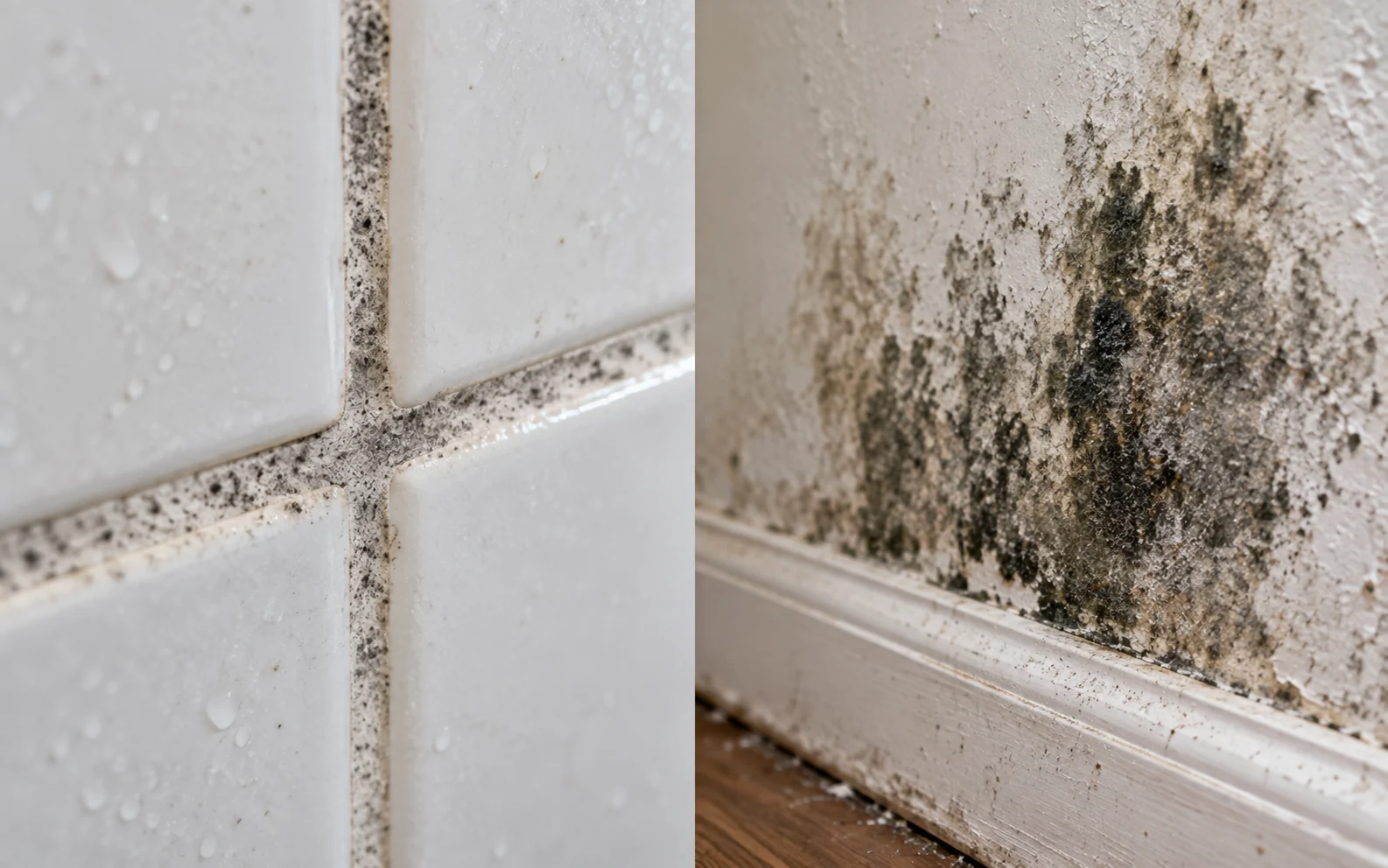
Mildew is usually flat, powdery, and white, grey or light yellow. It shows up on damp surfaces — shower tile, window sills, fabric — and stays on top of them.
Mold is typically raised or fuzzy in texture, ranges through green, brown and black, and appears on porous materials like drywall, wood and insulation, where it can grow into the material rather than sit on it.
Texture is a more reliable signal than colour. Colour varies enormously and tells you very little — “black mold” in particular is a colloquial description rather than a specific organism, and several common moulds appear black.
The wipe test isn’t conclusive on its own
A frequently repeated piece of advice is to dab the spot with diluted bleach: mildew fades quickly, mold usually doesn’t. It can help, but treat it as one signal rather than a verdict. It is unreliable on dark or painted surfaces, and it tells you nothing about how far growth extends behind the wall — which is the part that actually determines what the job is.
It also has a downside. Bleach on a porous surface adds water to material that is already damp, and can drive moisture deeper while only decolourising what sits on top. Something can look resolved and be entirely intact underneath.
The surface underneath is the real question
Ask what the growth is sitting on rather than what it looks like:
- Non-porous — glazed tile, glass, sealed metal. Growth stays on the surface and ordinary cleaning generally works.
- Semi-porous — finished wood, painted surfaces in good condition. Sometimes cleanable, depending on how long it has been damp.
- Porous — drywall, insulation, bare wood, carpet backing, ceiling tile. What is visible is rarely the full extent, and these materials are usually removed rather than cleaned.
A patch of mildew on shower grout and an identical-looking patch on a basement drywall seam are genuinely different problems.
When to stop guessing
Identification stops being the useful question once any of these are true: the area is bigger than roughly a square metre, it keeps returning after cleaning, it is on porous material, there is a musty smell with nothing visible, or you would have to open something up to reach it.
At that point what matters is extent and cause, not species — and both need looking at rather than photographing. An inspection answers how far it has gone and what is feeding it, which is what determines whether this is a wipe-down or a remediation job.