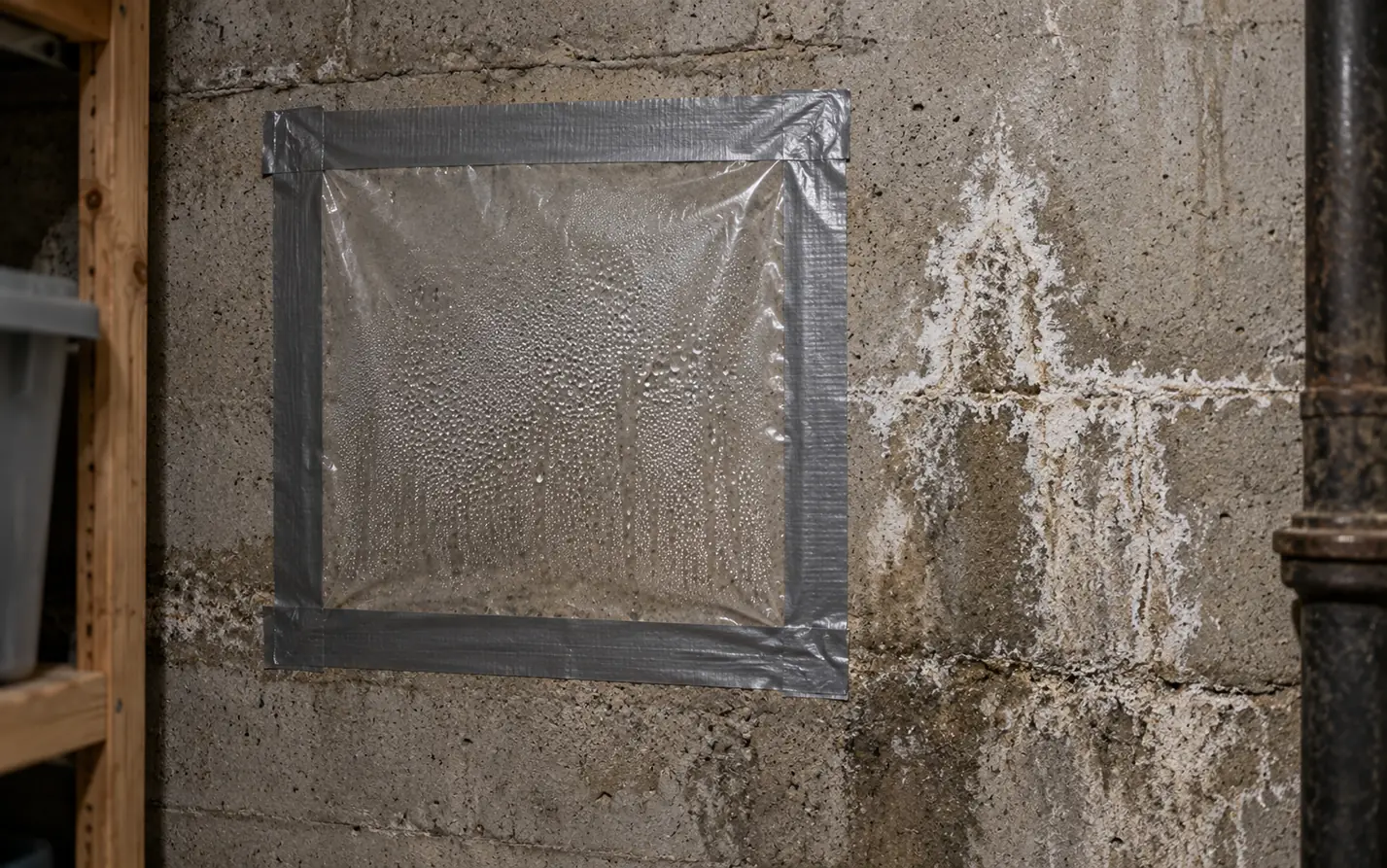
A damp basement has two very different possible causes, and the fix for one does nothing for the other. Condensation is moisture from the air collecting on cold surfaces. Water intrusion is liquid water moving through the foundation from outside. Buying a dehumidifier for an intrusion problem is one of the more common and expensive mistakes in an older home.
The plastic sheet test
This costs nothing and settles the question in about 48 hours.
Tape a piece of clear plastic sheeting — roughly a foot square — flat against a section of foundation wall that gets damp. Seal all four edges with tape so the patch is airtight. Leave it for two days, then look at which side is wet.
- Moisture on the room side of the plastic means humid air is condensing on a cold wall. That’s a condensation problem.
- Moisture trapped underneath, against the masonry means water is moving through the wall itself. That’s intrusion.
- Both is entirely possible, and is common in older foundations during a humid summer.
Why this matters in older housing stock
Much of West Roxbury’s housing stock predates the 1960s, and a large share of those homes sit on fieldstone or rubble foundations rather than poured concrete. Those walls are considerably more porous, and the clay-heavy soil common in this part of the city holds water against them rather than draining it away. That combination makes intrusion more likely here than in newer construction.
Summer adds the other half of the problem. Warm, humid air entering a cool basement condenses on masonry that stays cold year-round — which is why a basement that is bone dry in February can smell musty by July without a drop of water ever entering it.
Reading the other signals
Efflorescence — a white, chalky mineral residue on stone or concrete — is a strong indicator of intrusion. It is left behind when water moves through masonry and evaporates, depositing dissolved salts. It means water has been travelling through that wall, even if the wall looks dry today.
Staining at a consistent height around the perimeter suggests water rising or entering at a level, rather than condensing randomly.
Damp that is worse after rain points to intrusion. Damp that tracks with humid weather rather than rainfall points to condensation.
Cold-surface patterns — moisture concentrated on pipes, the bottom of walls, or an uninsulated corner — point to condensation.
What each one actually needs
Condensation is managed by controlling the air: a properly sized dehumidifier with a drain line rather than a bucket, insulating cold surfaces, and keeping humid outside air out during the muggiest part of summer. Counter-intuitively, opening basement windows on a hot humid day usually makes condensation worse, not better.
Intrusion is almost always fixed outside the house. Grading that slopes toward the foundation instead of away, gutters discharging next to the wall, and downspouts without extensions are the usual suspects, and they are frequently cheaper to correct than anything done indoors. Where groundwater is genuinely rising, a correctly sized sump system is the answer, not a dehumidifier.
Crawl spaces follow the same logic but concentrate it, because they are typically unconditioned, poorly ventilated and rarely inspected. A vapour barrier over exposed soil is often the single biggest improvement available.
Where mold enters the picture
Neither condition is mold in itself — both are conditions that allow it. Sustained dampness on porous material is what eventually supports growth, which is why moisture control and remediation are separate services that frequently need to happen together. Remediating growth without correcting the water is how the same wall ends up being treated twice.
If the plastic test comes back ambiguous, or you already have visible growth, that’s a reasonable point to have it looked at properly rather than guessing at which fix to buy.