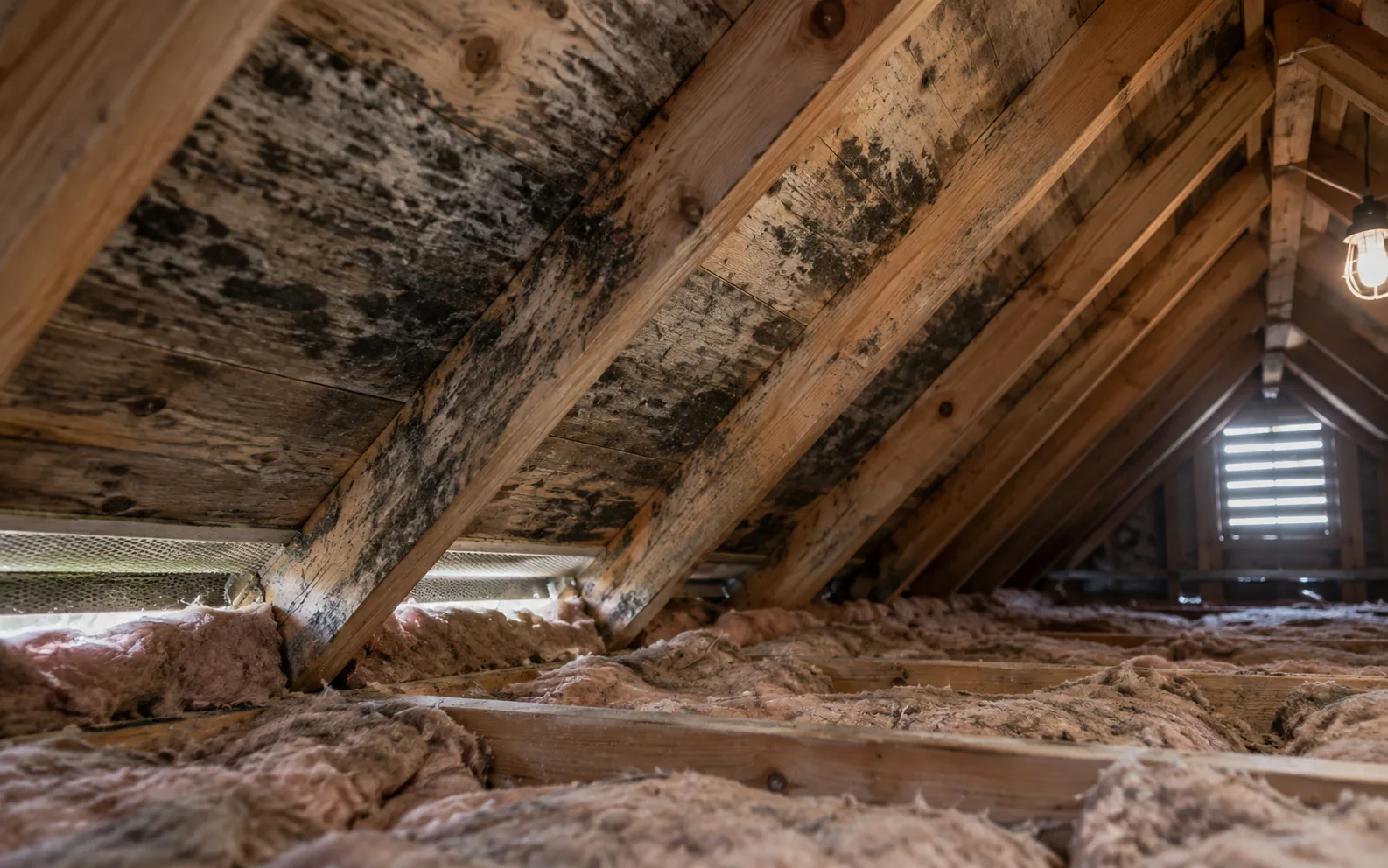
Most people who find dark staining across the underside of their roof sheathing assume the roof has failed. Usually it hasn’t. Attic growth is far more often a ventilation and air-sealing problem, and that distinction matters because replacing shingles won’t fix it.
Why warm air is the actual culprit
Attics are meant to stay close to outdoor temperature. When warm, humid air from the living space leaks upward — around recessed lights, the attic hatch, plumbing penetrations, or gaps at the top of interior walls — it meets cold roof sheathing in winter. The moisture in that air condenses on the first cold surface it touches, which is the underside of the roof deck.
That condensation happens over and over through the season. Plywood or board sheathing absorbs it, stays damp, and eventually supports growth. The pattern is usually the giveaway: staining that is heaviest near the roof edge, concentrated on the north-facing slope, or forming a band that follows the rafter bays rather than a single spreading blotch.
A genuine roof leak looks different. It tends to be localised, roughly circular, traceable to a specific penetration such as a chimney flashing or vent boot, and often accompanied by staining that continues down onto insulation or a ceiling below.
The three things that usually need checking
Blocked or absent soffit vents. Air is supposed to enter low at the eaves and exit high at the ridge. Insulation pushed tight into the eaves is one of the most common causes of blocked intake, and it is easy to do accidentally when topping up insulation. Baffles are what keep that channel open.
Exhaust fans venting into the attic. A bathroom or dryer fan that terminates inside the attic rather than through the roof or wall is effectively pumping warm, wet air directly at cold sheathing. This one cause can produce heavy growth on its own, and it is common enough to be worth checking first.
Air leakage from the living space. Even with good venting, a poorly sealed attic floor keeps feeding moisture upward. Sealing those paths usually matters more than adding more vents.
Where ice dams fit in
Ice dams and attic growth share a root cause. Heat escaping into the attic melts snow on the upper roof; the meltwater runs down to the colder eave and refreezes, building a ridge of ice that backs water up under the shingles. So a house with recurring ice dams is telling you something about its attic temperature — and that same escaping warmth is what drives winter condensation on the sheathing.
If you have had ice dams, the attic is worth looking at even if nothing is visible from inside the house yet.
What to do about existing growth
Surface growth on sheathing is generally treatable rather than a reason to replace the roof deck. The sequence matters though: treating the wood without correcting the ventilation and air sealing means the same conditions return the following winter, which is the most common reason attic problems are dealt with twice.
Affected insulation is a separate question. Insulation that has been repeatedly wetted loses much of its performance and is usually removed rather than treated, which is also an opportunity to air-seal the attic floor properly before new material goes in.
When it’s worth having someone look
An attic is an awkward place to assess from a phone photograph. Staining that covers several rafter bays, any sheathing that feels soft, insulation that is visibly compacted or damp, or a fan you suspect is venting into the space are all reasonable prompts for an inspection. What you want out of it is not just confirmation that there is growth, but an answer on which of the three causes above is actually driving it — because that determines whether the fix holds.